Table Of Content
A factorial design is a common type of experiment where there are two or more independent variables. This video demonstrates a 2 x 2 factorial design used to explore how self-awareness and self-esteem may influence the ability to decipher nonverbal signals. A 2×2 factorial design is a type of experimental design that allows researchers to understand the effects of two independent variables (each with two levels) on a single dependent variable. Observing the effects of at least two independent variables is a more practical and economical approach. This averts the need to expend time and resources for separate experiments.
HOPE-3 wades into fray regarding optimal blood pressure targets - MDedge
HOPE-3 wades into fray regarding optimal blood pressure targets.
Posted: Sun, 08 Oct 2017 07:00:00 GMT [source]
2 Designs
A common one to select is "Residuals versus fits" which shows how the variance between the predicted values from the model and the actual values. The default factors are named "A", "B", "C", and "D" and have respective high and low levels of 1 and -1. The name of the factors can be changed by simply clicking in the box and typing a new name. Additionally, the low and high levels for each factor can be modified in this menu.

6.4 SS Distraction by Reward
This is what was seen graphically, since the graph with dosage on the horizontal axis has a slope with larger magnitude than the graph with age on the horizontal axis. By the traditional experimentation, each experiment would have to be isolated separately to fully find the effect on B. This would have resulted in 8 different experiments being performed.
Qualitative vs. Quantitative Variables: What’s the Difference?
It’s when you become highly irritated and angry because you are very hungry…hangry. I will propose an experiment to measure conditions that are required to produce hangriness. The pretend experiment will measure hangriness (we ask people how hangry they are on a scale from 1-10, with 10 being most hangry, and 0 being not hangry at all). The first independent variable will be time since last meal (1 hour vs. 5 hours), and the second independent variable will be how tired someone is (not tired vs very tired).
We know the size of the Stroop effect must have been different between the standing and sitting conditions, otherwise we would have gotten a smaller \(F\)-value and a much larger \(p\)-value. We are now going to work through some examples of calculating the ANOVA table for 2x2 designs. We will start with the between-subjects ANOVA for 2x2 designs.
However, the main effect of congruency does not say whether the size of the Stroop effect changed between the levels of the posture variable. So, this main effect was not particularly important for answering the specific question posed by the study. Do you pay more attention when you are sitting or standing? This was the kind of research question the researchers were asking in the study we will look at. In fact, the general question and design is very similar to our fake study idea that we used to explain factorial designs in this chapter.

Whereas, in the other conditions, there are only small increases in being hangry. The table shows the mean RTs, standard deviation (sd), and standard error of the mean for each condition. Mean incongruent RTs were slower (larger number in milliseconds) than mean congruent RTs. The main effect of congruency is important for establishing that the researchers were able to measure the Stroop effect.
The other was private body consciousness, a variable which the researchers simply measured. Another example is a study by Halle Brown and colleagues in which participants were exposed to several words that they were later asked to recall [BKD+99]. The manipulated independent variable was the type of word. Some were negative, health-related words (e.g., tumor, coronary), and others were not health related (e.g., election, geometry). The non-manipulated independent variable was whether participants were high or low in hypochondriasis (excessive concern with ordinary bodily symptoms).
It helps you know that you know what you are doing, and what the ANOVA is doing. We can’t make you do this, we can only make the suggestion. If we keep doing these by hand, it is not good for us, and it is not you doing them by hand. I have a Master of Science degree in Applied Statistics and I’ve worked on machine learning algorithms for professional businesses in both healthcare and retail.
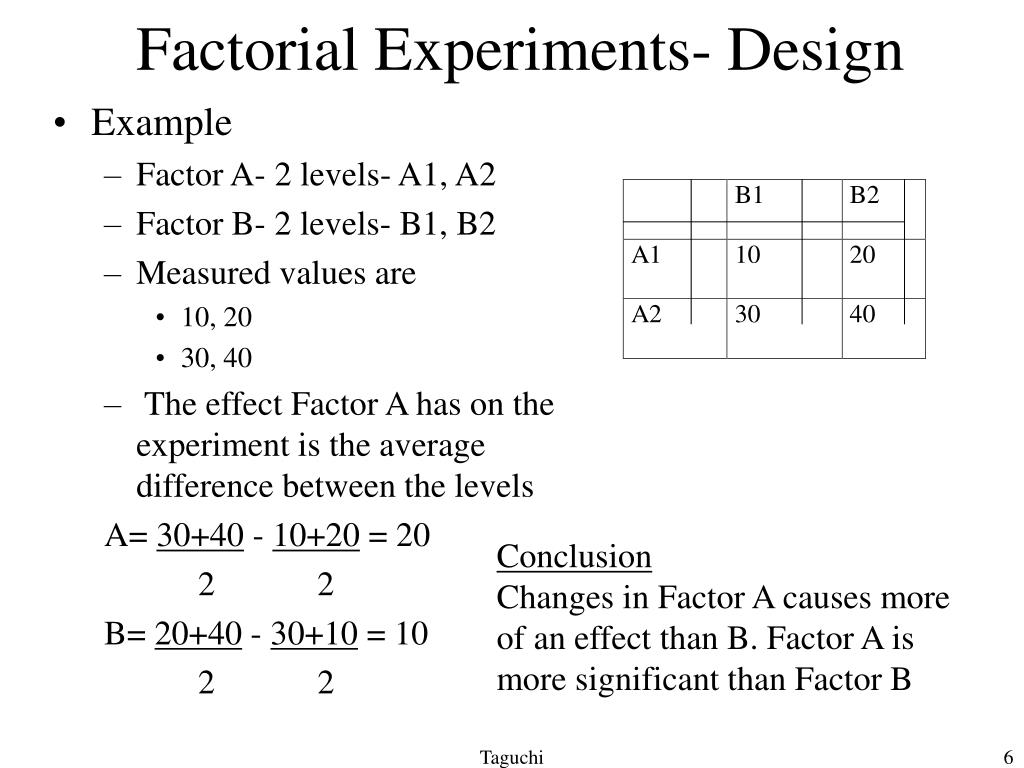
To get a mean factorial effect, the totals needs to be divided by 2 times the number of replicates, where a replicate is a repeated experiment. It doesn't matter statistically which IV is placed where, it's more about interpreting and understanding what is besting tested. If researchers can identify factors that cause greater accuracy in understanding non-verbal communication, it is possible that individuals can learn how to read other’s nonverbal signals better. Think of all of the contexts where being able to accurately understand a person’s expressions would help.
Factorial experiments can be used when there are more than two levels of each factor. However, the number of experimental runs required for three-level (or more) factorial designs will be considerably greater than for their two-level counterparts. Factorial designs are therefore less attractive if a researcher wishes to consider more than two levels.
After the number of factors is chosen, click on the "Designs..." option to see the following menu. Create a "Punnett's Square" for the IV of Mindset (Growth or Fixed) and the IV of Job (Full-Time, Part-Time, or None) for time spend studying. For example, for participants who were rewarded, some are distracted and some are not. Similarly, for participants who were not rewarded, we distract some of the participants and don't distract some of them. Just for fun, let’s illustrate a 2x3 design using the same kinds of tables we looked at before for the 2x2 design. Similarly, observing participants’ preferences between these foods when served warm versus cold relates to the main effect for temperature.
The ANOVA Summary Table will give us main effects for Congruency and Posture (the two IVs), as well as one interaction effect to evaluate (Congruency X Posture). The interaction effect tells us whether the congruency effect changes across the levels of the posture manipulation. People who are good at ignoring the distracting words should have small Stroop effects. They will ignore the word, and it won’t influence them very much for either congruent or incongruent trials. As a result, the difference in performance (the Stroop effect) should be fairly small if you have “good” selective attention in this task.


No comments:
Post a Comment